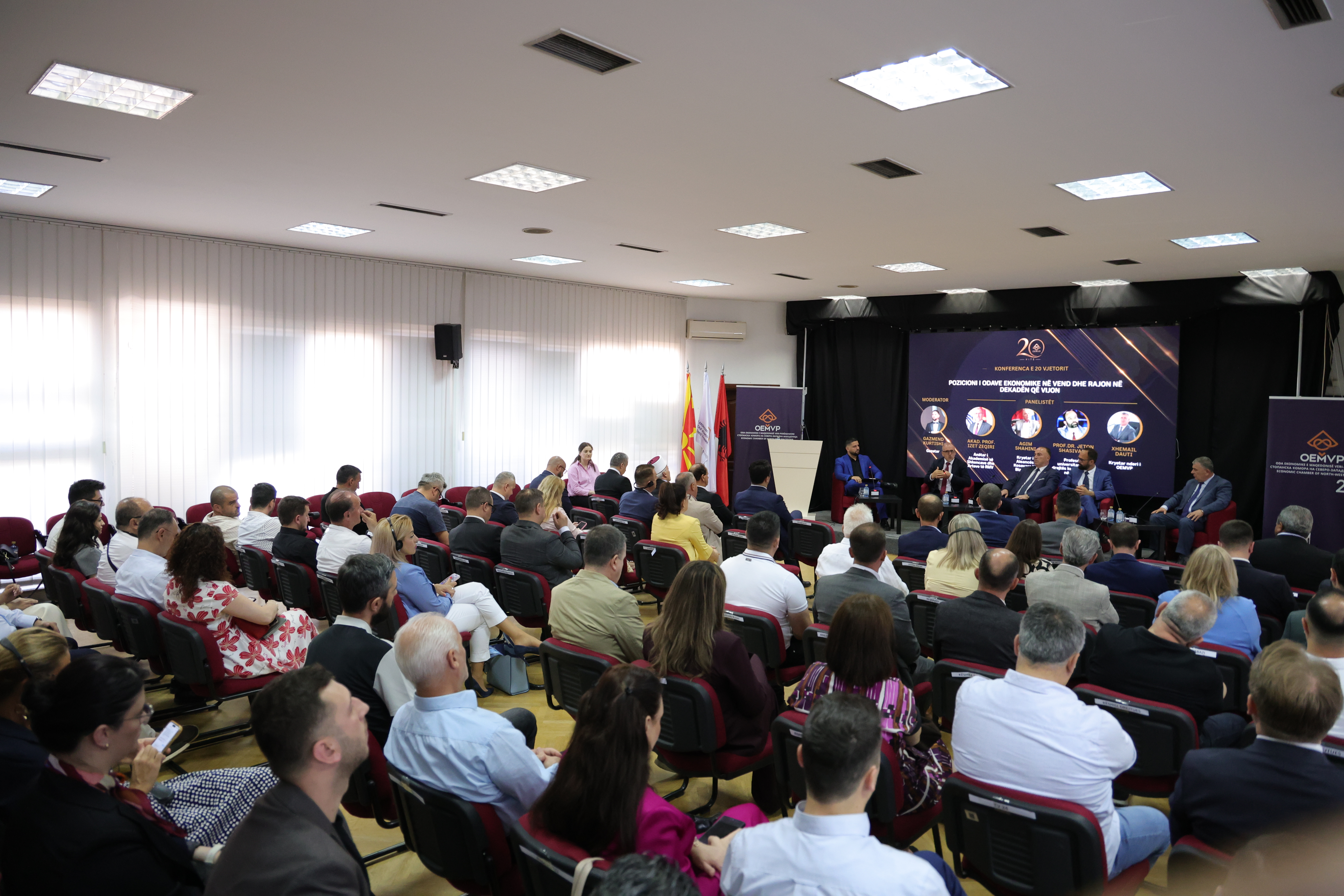
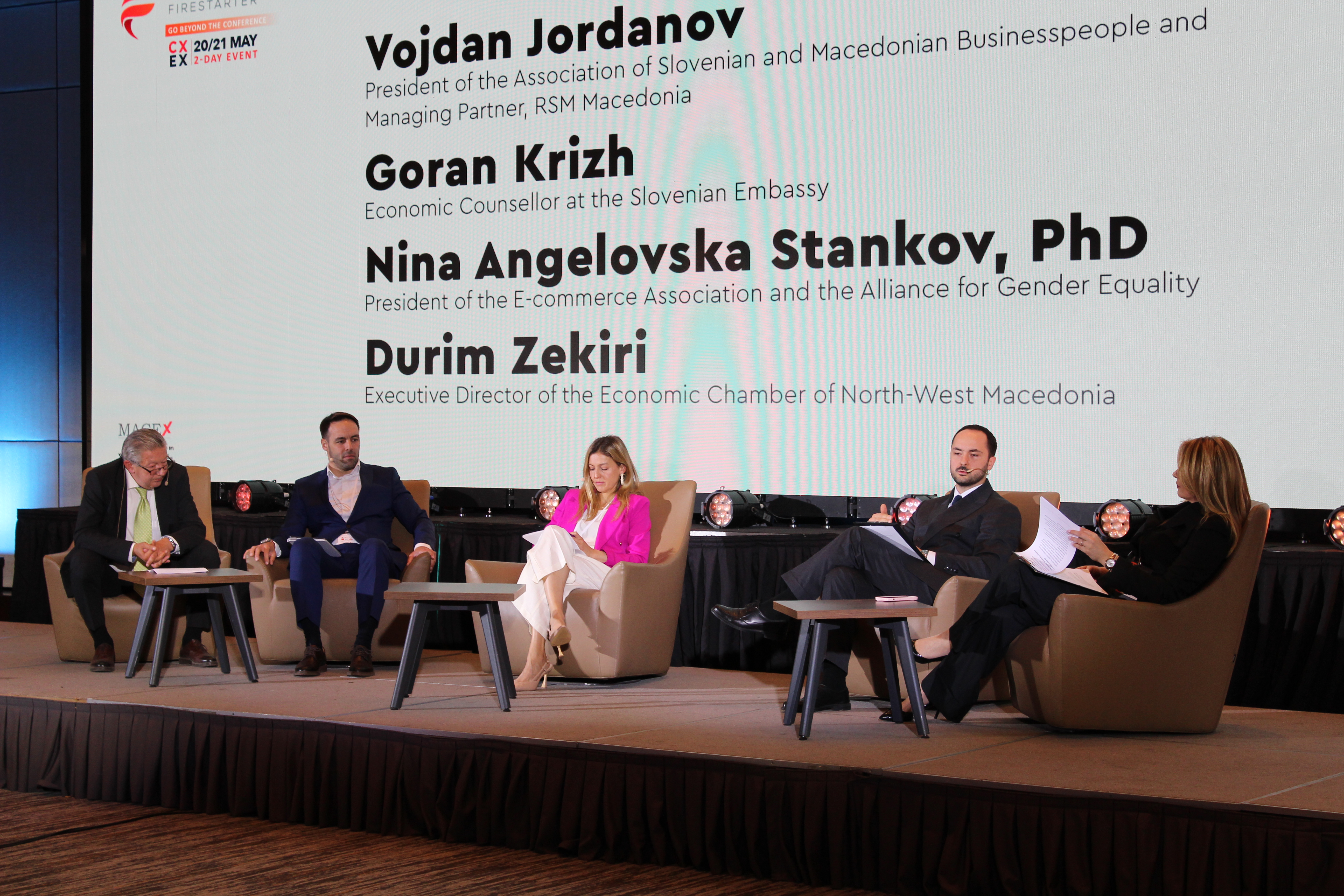
The Executive Director of the Economic Chamber of North-West Macedonia, Durim Zekiri, participated as a panelist at the event organized by the Macedonian Association for Customer and Employee Experience (MACEX), where the topic was discussed: “Building experience-oriented economies: The role of economic chambers and business associations in supporting organizational transformation”. The panel also included Ms. Nina Angelovska Stankov, Mr. Vojdan Jordanov, Mr. Goran Kriz, and was moderated by Hristina Velkovska.
During the discussion, Mr. Zekiri emphasized that: “A good employee experience means higher productivity at the national level. When employees are motivated and satisfied, companies are more efficient, more competitive and produce more, contributing directly and positively to the country’s GDP. Employee experience creates a more resilient and innovative economy, while companies that invest in their employees have lower turnover, better adaptation to crises and long-term economic stability.”
To the question: “Since the North-West region has great entrepreneurial potential, what is needed to transform that potential into innovative, economic and sustainable development?”, Mr. Zekiri replied that the Polog region has the youngest population in the country. “This means that the region has the greatest long-term potential, yet it ranks third among all regions in terms of the number of registered companies per capita. To capitalize on this potential, a strategic approach is needed. The Skopje region dominates in almost every economic aspect, with 54% of the country’s total exports coming from this region. Meanwhile, state investments have been lowest in the Polog region and the South-West region over the past 30 years.”
Further, Mr. Zekiri emphasized that: “If Skopje is the economic engine of the Republic of North Macedonia, then the Western bloc represents the most untapped economic potential. With more developed infrastructure, greater investments, industrial diversification and more pronounced decentralization, the western region could become the second economic center of the country.”
The panel served as a platform for the exchange of ideas and experiences on ways in which organizations and the business community can contribute to creating more flexible, modern and market-ready companies.